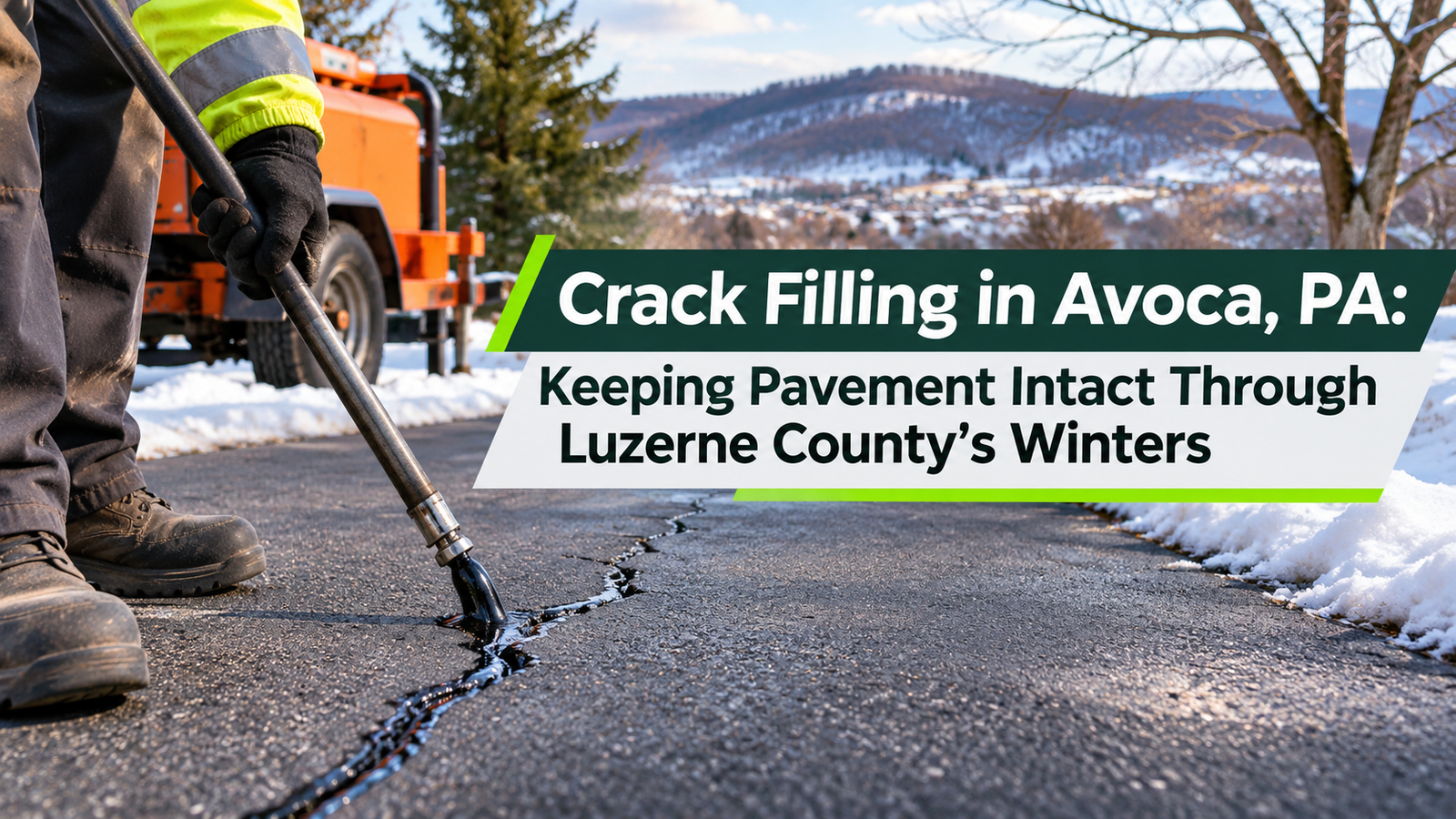
Crack filling is the entry point of asphalt pavement maintenance the first active step that property owners in Avoca and throughout Luzerne County should take when cracks appear in their asphalt. Done early and done right, crack filling is one of the most cost-effective maintenance activities available, addressing the primary mechanism by which Pennsylvania pavement fails: water infiltration through surface cracks, into the base and subgrade, and the freeze-thaw destruction that follows. This article explains what crack filling Avoca involves, when and how to do it, and what property owners should understand about this fundamental part of asphalt maintenance in a northeastern Pennsylvania climate.
Why Cracks in Pennsylvania Pavement Are Urgent
In a mild, relatively warm climate, an unsealed crack in asphalt is primarily a cosmetic and water infiltration concern. In Pennsylvania’s climate with temperatures that regularly drop well below freezing from November through March and that cycle above and below freezing repeatedly during transitional months an unsealed crack is an actively destructive feature. Water that enters the crack freezes when temperatures drop below 32°F. Water expands approximately 9 percent when it freezes, creating internal pressure in the crack and in the base material below. This pressure widens the crack, undermines the base, and creates the conditions for further deterioration.
Each freeze-thaw cycle advances this destruction incrementally. A crack that is 1/4 inch wide in October can be 1 inch wide by March after a winter of freeze-thaw cycling with water access. The softened, saturated base below an unsealed crack loses load-bearing capacity, and vehicle traffic on a compromised base causes the rapid alligator cracking and pothole formation that characterizes the worst of Pennsylvania’s spring pavement damage. Avoca and the surrounding communities see this pattern play out every year on streets and driveways that entered winter with open cracks.
Types of Crack Filler and Their Applications
Crack filling products vary significantly in composition, application method, and performance, and understanding the options helps property owners and contractors choose the right product for the situation. Cold-pour crack filler is the most accessible option: a liquid, rubberized asphalt material that is poured directly from a jug into the crack without special equipment. Cold-pour fillers are appropriate for narrow cracks (1/4 inch or less) in otherwise sound pavement. They are easy to apply and are the common choice for routine residential driveway maintenance.
Hot-applied rubberized sealant the material used by professional contractors for crack sealing operations is a polymer-modified asphalt compound that is melted in a specialized melter-applicator to approximately 375 to 400°F and applied with a wand. The hot application temperature allows the sealant to flow into the crack and bond to the crack faces, creating a more durable, more flexible seal than cold-pour products. Hot-applied materials are significantly more effective for wider cracks, active cracks, and any application where long-term durability matters.
Foam crack filler a polyurethane foam that expands to fill the crack is used in some applications, particularly for wide cracks where the volume of material needed makes liquid fillers impractical. Backer rod (a foam cylindrical insert placed in wide cracks before sealant application) is used to control the depth of sealant in routed channels, ensuring the sealant has the proper shape factor for flexibility without using excessive amounts of material.
Crack Filling vs. Full Pavement Repair: When Each Is Appropriate
Crack filling is a maintenance activity appropriate for structurally sound pavement with surface cracking. It is not a structural repair it does not restore the pavement’s load-bearing capacity, fix a failed base, or address significant settlement or deformation. Knowing when crack filling is the right activity and when more comprehensive repair is needed is important for making good maintenance decisions.
Crack filling is appropriate when: cracks are transverse, longitudinal, or edge cracks without significant width or branching; the pavement on either side of the crack is firm and stable (not soft, spongy, or showing deformation); alligator cracking is absent or limited to small isolated areas; and the overall pavement is otherwise serviceable. It is not appropriate as a standalone treatment when: alligator cracking is widespread; there is significant settlement or deformation; or the base is clearly failing, as indicated by pumping (water-saturated base squeezing up through cracks under wheel loads).
A common mistake is filling cracks in a pavement that needs base repair or replacement, then wondering why the repairs failed within one season. Crack filler applied over a failed base delays the visible sign of distress briefly but does not stop the underlying structural failure. The correct sequence is to fix structural problems first, then seal the surface.
Preparing Cracks Before Filling in Pennsylvania
The quality of crack preparation determines the quality and longevity of the fill. Cracks should be cleared of debris, vegetation, and loose material before filling. A wire brush or compressed air is effective for cleaning narrow cracks. Larger cracks with established weed growth (common in older Avoca driveways and parking lots) need vegetation removal herbicide treatment a few weeks before filling ensures the roots are dead and not just the visible growth. Wet or damp cracks should be dried before applying sealant; in fall and spring work in Pennsylvania, using a heat lance or even a propane torch to dry the crack faces is standard practice for professional crack sealing crews.
For wide cracks being treated with hot-applied sealant, routing cutting the crack to a uniform 3/4 inch by 3/4 inch channel dramatically improves performance by creating clean, fresh bonding surfaces and a reservoir shape that holds material and accommodates movement. The investment in routing pays back in sealant service life: a routed and sealed crack typically lasts twice as long as a simple filled crack in Pennsylvania’s climate.
Maintaining Crack Repairs and Re-Treatment Schedules
Crack fill is not a permanent repair it is a maintenance treatment that must be renewed periodically as the sealant ages, cracks through cold-temperature cycling, or is displaced by traffic. Inspecting crack-filled areas in spring, after the winter freeze-thaw season, identifies fills that have failed and need re-treatment. Prompt re-treatment of failed sections prevents the exposed crack from spending an additional summer and fall accumulating water before the next winter.
Cold-pour fills typically need re-treatment every two to four years in Pennsylvania’s climate. Hot-applied fills in routed channels last five to eight years. Building crack inspection and re-treatment into an annual property maintenance routine checking condition in spring and scheduling any needed maintenance before the summer construction season is in full swing keeps the pavement in front of deterioration rather than reacting to failure.
Frequently Asked Questions: Crack Filling in Avoca, PA
How wide should a crack be before it needs to be filled?
Any crack wider than a hairline is a pathway for water infiltration and should be filled, though the urgency and the appropriate filler type depend on width. Very fine cracks (less than 1/8 inch) can often be addressed by sealcoating alone, as the sealcoat material bridges fine cracks. Cracks from 1/8 to 1/2 inch are prime candidates for cold-pour or hot-applied crack filler. Cracks wider than 1/2 inch should be routed and sealed with hot-applied material or repaired with saw cutting and patching if the adjacent pavement is structurally compromised.
Can crack filler be applied before sealcoating a driveway in Pennsylvania?
Yes and it should be. The correct sequence for comprehensive driveway maintenance is to fill cracks first, allow the filler to cure fully, and then apply sealcoat. Applying sealcoat over unfilled cracks leaves the cracks open to water infiltration, which undermines the sealcoat’s function. Sealcoat material is too thin to bridge cracks effectively on its own. Filling cracks first and sealing after is the sequence that gives both treatments their best performance.
Does crack filling require a permit in Pennsylvania?
No crack filling and routine asphalt maintenance on private residential or commercial property does not require a building or construction permit in Pennsylvania. It is routine maintenance work. Work on public road right-of-way (utility cuts, driveway connections to public roads) requires municipal or PennDOT permits as applicable, but private property maintenance of existing asphalt surfaces does not trigger permit requirements.
Why do filled cracks sometimes reopen after one winter in Pennsylvania?
Crack fills reopen most commonly for a few reasons: the crack was not properly prepared (wet, dirty, or weed-contaminated crack faces that prevented bonding); a cold-pour product was used on a wide or active crack that required a more flexible hot-applied material; the fill was applied in cold conditions that prevented proper bonding or curing; or the crack is structurally active from base movement that exceeds the fill material’s flexibility. Using the right product for the crack type, preparing the crack correctly, and applying in appropriate weather conditions are the keys to fills that survive Pennsylvania winters.